

Access rules come before similarity
Memory candidates pass access and validity filters before relevance ranking. A highly similar item must not bypass its owner or sharing boundaries. The graph applies the same access discipline when showing related information.
Read provenance with the content
A useful memory carries source links, authorship, dates, ownership and revision history. Those details help establish whether information is current and trustworthy. Semantic similarity identifies a candidate; it does not validate the underlying fact.
Inspect why information was recalled
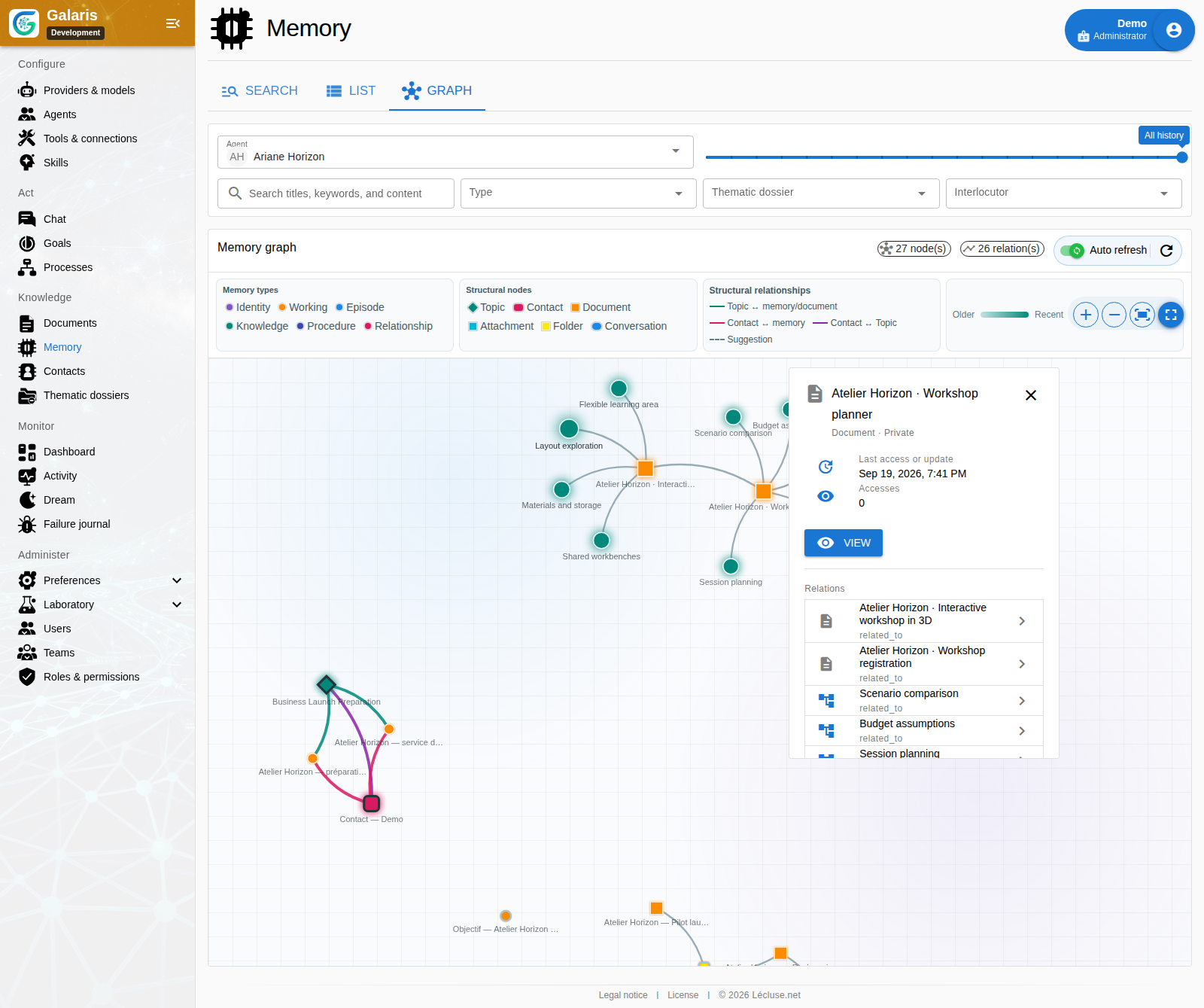
The interface exposes memory items, relationships and recall traces. Review the underlying record when an answer uses unexpected context. Compare the selected version, access scope and source instead of treating a generated response as its own evidence.
Forgetting must affect future retrieval
Authorised forgetting removes the memory, its revisions and related index entries. A content-free fingerprint prevents the same source from automatically recreating it. Exported copies, backups and original source systems follow their own retention rules. Merely marking an item as old does not remove it from recall.
Share without discarding other access rules
New resources are private. Owners can combine individual grants, teams and public access within the application. Removing a direct grant does not remove access still obtained through a team. Write access alone does not allow resharing.
Document restoration creates a new content revision without restoring old grants. Expired memories remain excluded from recall; conversational acquisitions retain the proven identity of the interlocutor.
Filing and attachments follow access rights
A personal folder grants no independent access. Paths visible in memory depend on readable documents; a forbidden object cannot become a graph bridge. Removing an attachment hides it from current search while it may remain for earlier versions. Permanently forgetting a document also removes its attachment descriptions and revisions.
A page and its data have separate access
A Dataset is a JSON document with its own owner, sharing and versions. An application can use the same data as other pages without inheriting its author’s rights.
Sharing the page, sharing the Dataset and approving application access are three separate decisions. Each reader consents to the content version in addition to holding current access rights. Revocation prevents future calls; it does not undo writes already recorded. Data changes remain in Dataset history.