

1. Define a verifiable result
“Do some research” leaves too many decisions implicit. Write a brief specifying the question, permitted sources, expected format and the point at which you want to review the work. For example: prepare a decision brief from three notes, cite sources and distinguish contradictions from established facts.
This describes a trial, not a guaranteed performance. The Atelier Horizon kit provides three synthetic notes and a human-written reference for comparison. Keep the same case when you change the configuration.
2. Start with one agent and a useful specialist
One agent may be enough to read the notes and draft the synthesis. Add a specialist when a distinct responsibility justifies it: checking sources, examining an assumption or reviewing the document. Define what they should return to the coordinator instead of simply asking them to participate.
In Galaris, agents must share a team for the supported exchanges and delegations. Membership does not grant access to another user’s private conversations. Review team configuration and multi-agent collaboration.
3. Choose models, tools and permissions
Choose a model compatible with the work and your instance’s resources. Local models and remote services have different constraints; check the required capabilities rather than choosing by name alone. Models and harnesses explains the difference between a model and a task execution engine.
Give each role the documents and functions it needs. An agent reading a source may not need to edit it. Review tool permissions and test the MCP connections actually used. Team membership and document sharing are separate decisions.
4. Run a bounded mission
Start with the brief, sources and a single deliverable. Specify permitted actions and those requiring a human decision. For this research trial, request a synthesis you can review before any external distribution.
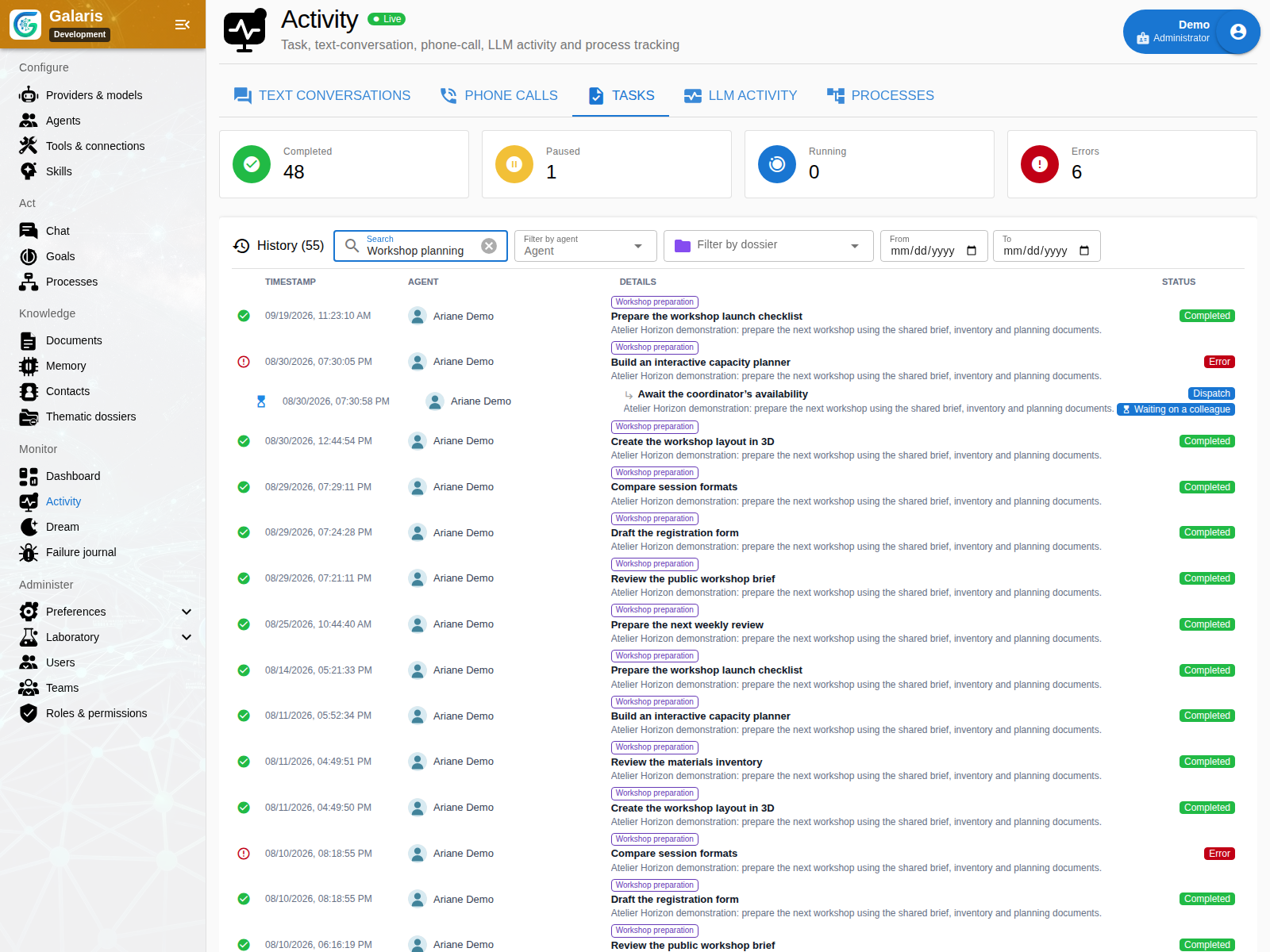
Follow missions and plans: which step is running, whose contribution is pending and what result is available? If information is missing, clarify or correct the brief. Having several agents does not remove the need for a clear objective.
5. Review the result before expanding
Check sources, identified contradictions and unresolved questions. Compare the output with your reference, then record review time and available costs. A failure may come from the brief, missing access or the model; add a role only after identifying the need.
To prepare a second mission, decide what belongs in durable memory. Check sources and sharing scope. Reusable knowledge must be correctable; storing a statement does not make it true.
6. Try it on your own instance
Follow installation on GitHub, the reference for commands and prerequisites. Self-hosting lets you manage your instance; connected services retain their own data flows and terms.
Galaris is in alpha. Start with trial data and the first mission protocol. If you only need a one-off answer, the AI agent or chatbot guide helps you adjust the scope.