
Model, profile and harness
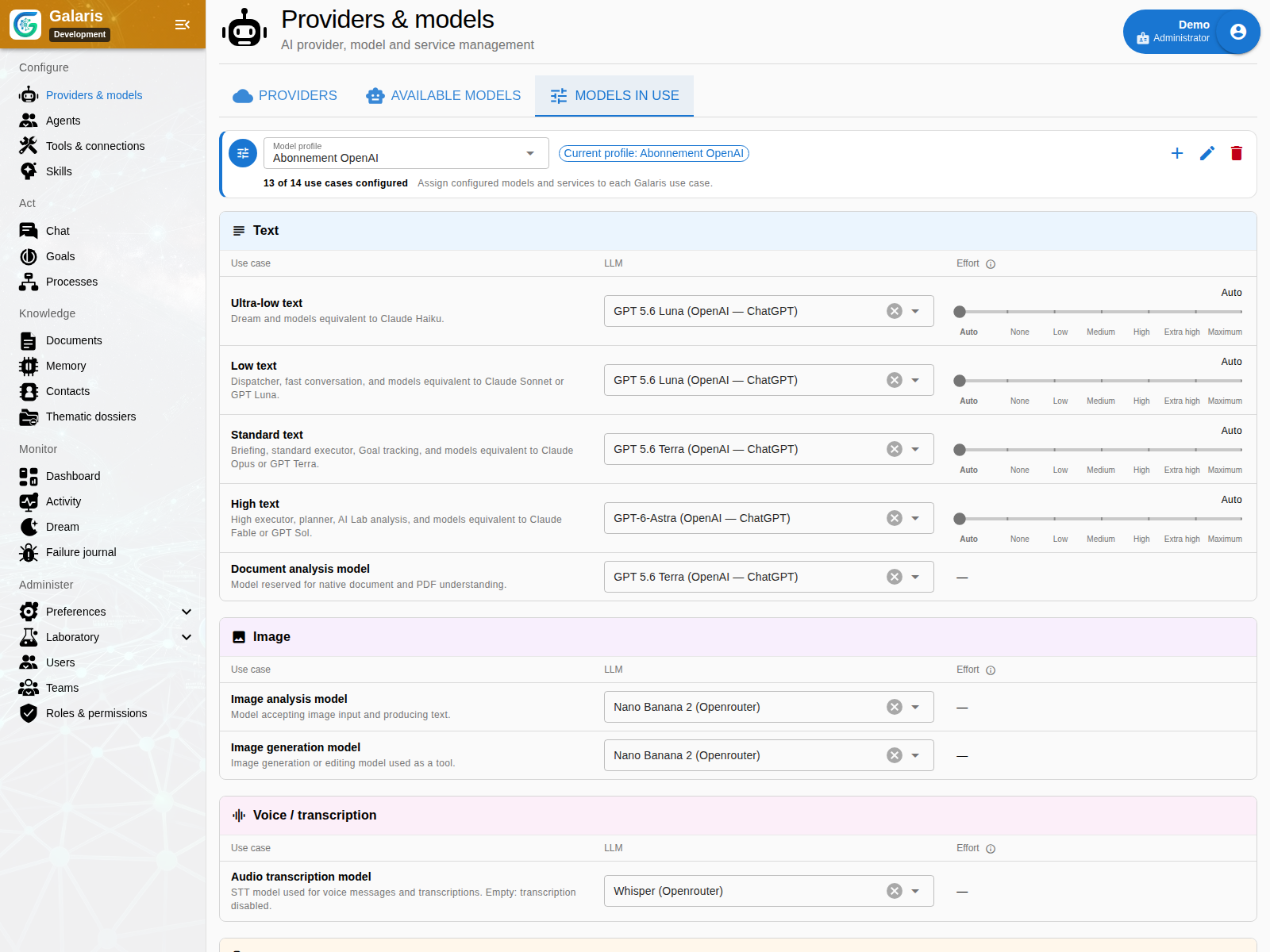
Providers expose inference resources. A model performs a particular use; a profile organises those choices. A harness executes Tasks only and never receives the conversation round. Chat uses its internal controller and conversation resource.
Four text tiers and specialised resources
| Tier | Uses |
|---|---|
| Ultra low | Dream mechanisms using a model |
| Low | Dispatcher and conversation |
| Standard | Standard execution, Goal follow-up and retained Briefing |
| High | High execution, Planner and Lab |
Reasoning effort is separate. Vision, documents, embeddings, images, transcription, audio/video analysis and media generation have dedicated selections. Voice is selected for an agent or user.
An explicitly selected profile is exclusive: missing resources are not silently borrowed from another profile. Without a specific selection, the agent or person follows the current profile.
Connect and manage providers
Test a connection, discover models and select resources. Catalogue information can include modalities, context and available pricing; unknown costs do not become zero. Ollama also supports model management through its bridge.
| Family | Present integrations |
|---|---|
| Text and multimodal by resource | OpenAI, Anthropic, Gemini, OpenRouter, Mammouth AI, DeepSeek, Fireworks, Groq, Mistral |
| Other inference catalogues | Together, Cerebras, xAI, NVIDIA, Hugging Face, Cohere, Perplexity |
| Voice and media | ElevenLabs, Google Cloud TTS, Azure Speech, SunoAPI.org, BytePlus LAS |
| Local models and metadata | Ollama; models.dev for catalogue enrichment |
Actual accounts, models and modalities depend on the provider. Supported personal device-code authentication remains tied to its human owner.
The gateway adapts parameters to provider and endpoint contracts. An explicit rejection before generation can allow removing only the rejected optional setting and making a bounded retry. A timeout or partial stream does not trigger this removal; messages, tools, budgets and output format remain intact.
Choose each agent’s harness
| Harness | Role in Galaris |
|---|---|
| Internal Pydantic AI | Native execution, planning, deferred tools and effect checkpoints |
| Hermes | Autonomous per-agent runtime, shared memory and projected skills |
| Claude Agent | Per-agent SDK, Anthropic gateway and Galaris MCP |
| Codex | Managed runtime with tools and telemetry adapted to the common contract |
| DeepSeek Harness | DSH instance with adapted execution and streaming |
| Remote Chat Completions compatible | Configured server URL, model, authentication and capabilities |
Manage the lifecycle
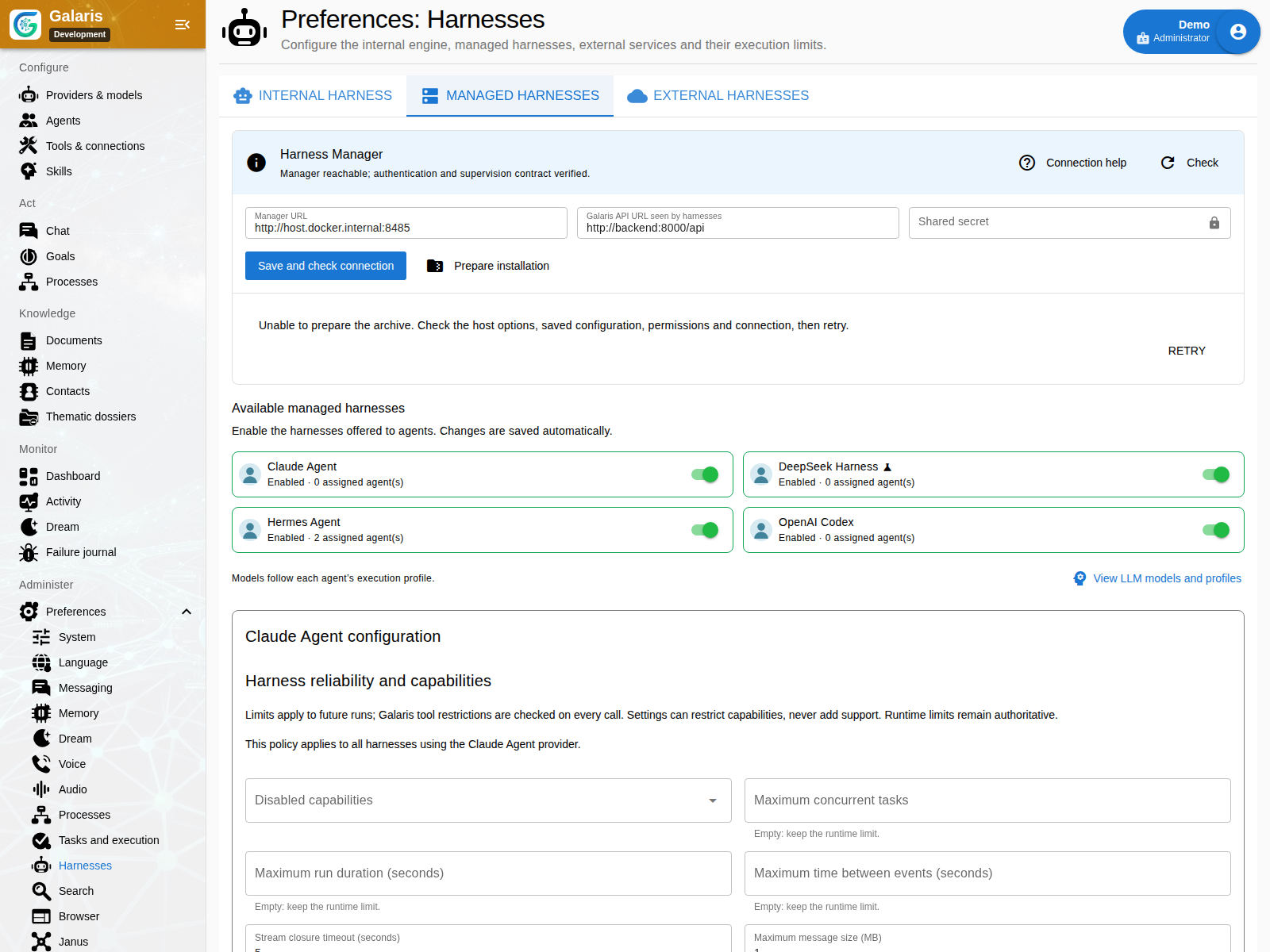
Depending on the provider, inspect state, errors, logs and files; provision, start, stop or update the runtime. Long operations are tracked. Unfinished tasks can block an environment change.
Selecting a containerised harness does not automatically provision it. External providers currently admit one concurrent run per instance. Internal harness guarantees do not automatically extend to every adapter.
Architecture · API gateways · Compare approaches
Modes supported by the selected harness
| Harness | Available modes |
|---|---|
| Internal | Standard execution, high execution, high plan |
| Managed Hermès, Codex, Claude Agent, DeepSeek Harness | Standard and high execution |
| Generic compatible server | Standard execution |
The four managed runtimes currently use Galaris’s model gateway. A native SDK reasoning option alone does not enable high execution. Briefing remains disabled in current policies, while available in historical records and the Lab. The Dispatcher selects only permitted modes; a single choice needs no model routing call.
Administration sets policies and limits per provider. Effective capabilities combine implementation, configuration and target verification. A requested stop is distinct from a confirmed remote stop.
The personal ChatGPT connection requires recorded explicit consent from its owner. Revoking consent blocks calls even when authentication remains connected.
Native multimodal inputs in the internal engine
Attached images, audio, video and PDFs can be supplied directly to the model in chat and Tasks using the internal engine. Eligibility combines declared model capabilities, MIME type and what the transport can actually serialise.
Audio/video inputs use the same model through the compatible protocol; video requires a declared provider adapter. Support does not automatically extend to external harnesses. Access rights, size and a total budget are checked; refusals and unsupported formats are reported to the model. Media workflow details.
Measure the differences before choosing
A model or harness change deserves evaluation on your own workloads. The Lab lets you compare models and mechanism configurations on the same cases: results, stability, time and available costs. Complement these measurements with a trial of the chosen harness using its own tools and capabilities.
Change engines while keeping connections in the hub
Hermes Agent, DSH (DeepSeek Harness), Codex, Claude and the internal harness can consume the agent’s authorised tools. Configure MCP servers and their functions in Galaris; the engine receives a projection appropriate to its permissions and execution context. Capabilities and recovery behaviour remain specific to each engine.
For example, Telegram can carry the request, Hermes can execute the task and a Notion MCP connection configured in Galaris can provide page operations. Choosing an engine does not dictate your chat interface or document workspace. See the setup and prerequisites.
Explore the ecosystem compatible with Galaris: inference providers, messaging, harnesses and services, with links to their reference websites.