

Recent context and lasting knowledge
Recent messages help continue a conversation. Lasting memory can affect later work and therefore has its own source, ownership, validity and revisions. Keeping these distinct makes retained knowledge easier to inspect.
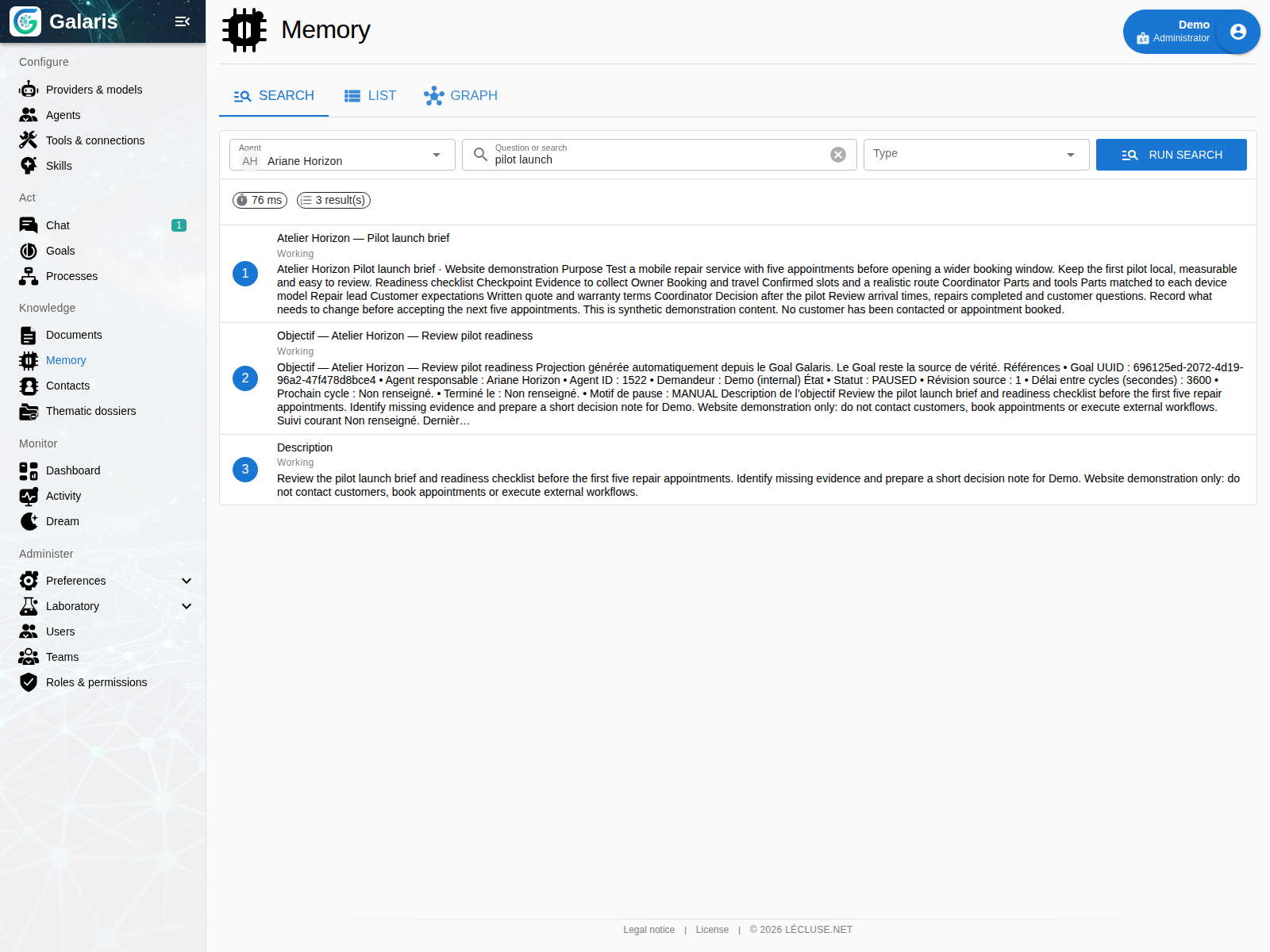
Retrieve relevant passages
Recall combines lexical content, embeddings, topics and confirmed relationships. Access and validity are checked before ranking. If vector search is unavailable, a lexical fallback is identified; weak evidence can produce an empty result.
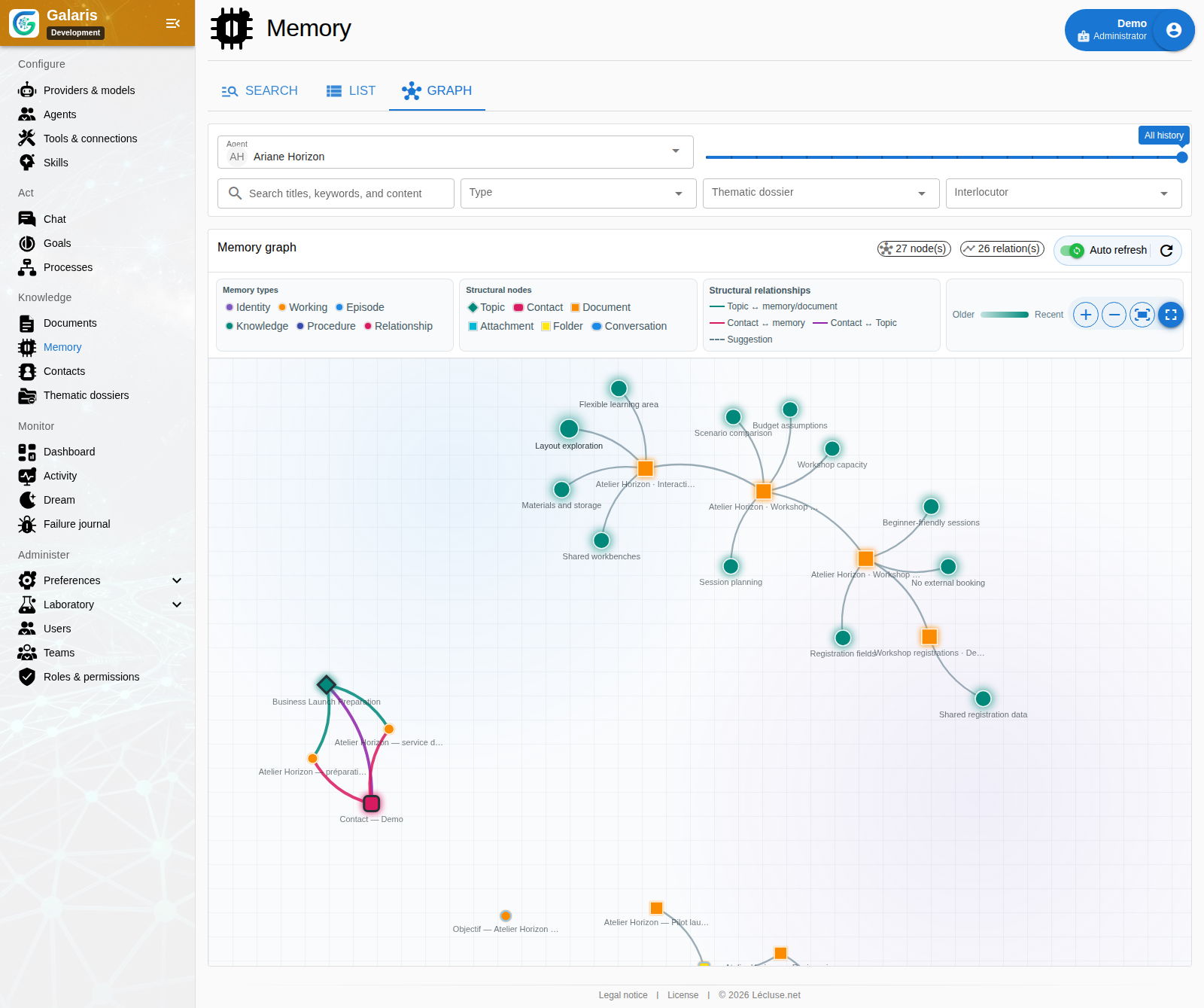
Explore connections in the graph
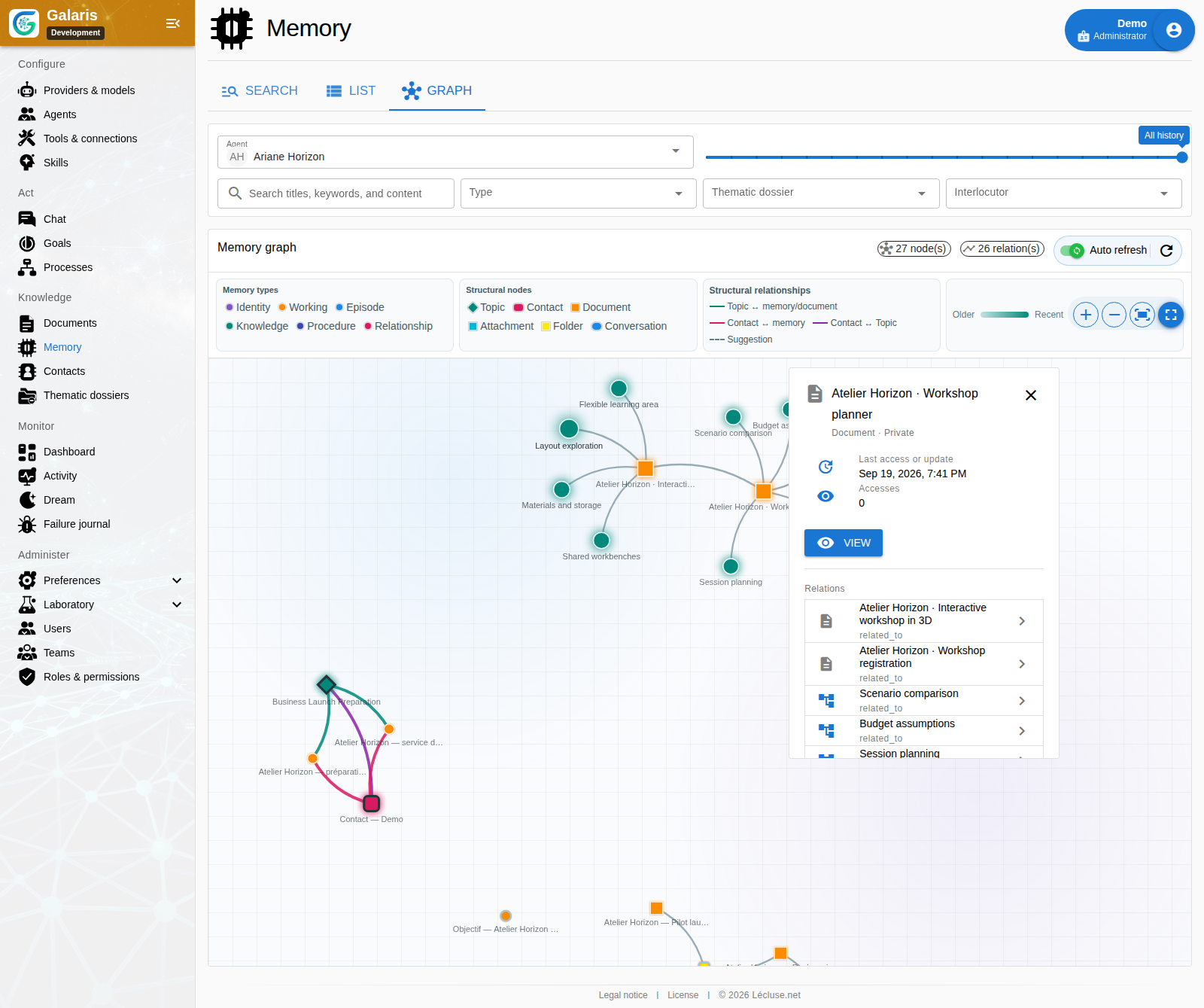
Navigate memories, documents, topics, contacts and conversations. Filter types and periods, expand a neighbourhood and open a node to inspect its content and provenance. Large views are bounded to remain usable.
Keep knowledge verifiable
Stored content can be traced to authors, tasks, source material and earlier versions. Inspect a source before treating a recalled statement as established fact. Documents and topics connect the retained information to working material.
Read, share and forget separately
Reading does not grant the right to reshare. Editing, ownership and deletion are separate controls. Authorised forgetting removes the covered memory and revisions, while protected domain objects follow their own rules.
Inspect background consolidation
Dream classifies and extracts from authorised sources, then records prepared and applied decisions. CREATE, LINK and IGNORE proposals pass server controls. The presence of a conversation does not imply that every message becomes permanent memory.
Edit content and read its history
Identity, Working, Episodic, Knowledge, Procedural and Social are the six memory types. Nature—memory, document, attachment or folder—is a separate classification. Edit content and keywords in the shared form. Previews come from current content, with no separate summary or free-text change reason to maintain.
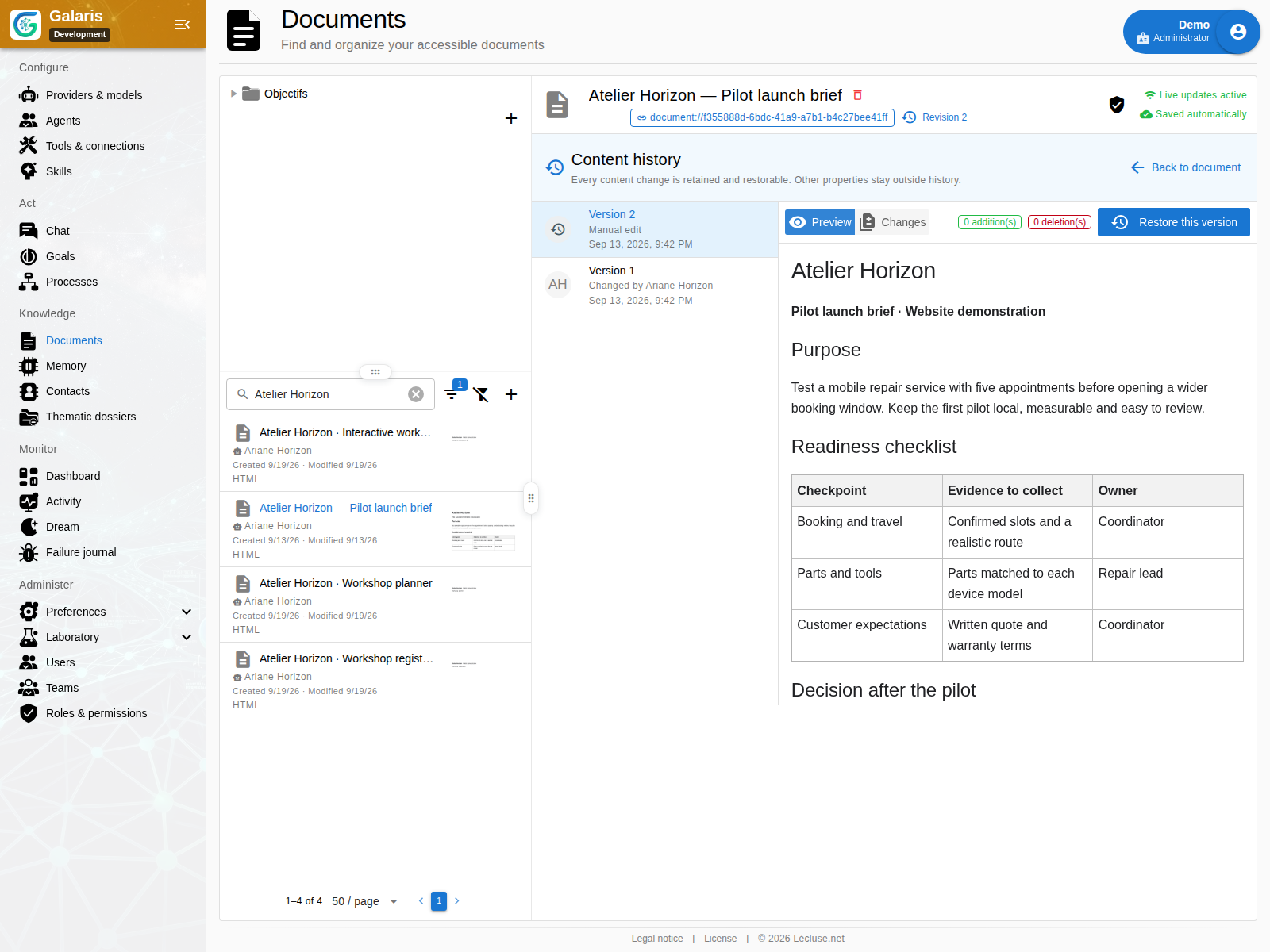
History opens earlier versions without abandoning the current draft. Dates, authors, tasks and sources retain traceability. Expired memories remain excluded from recall; a fact confirmed for a new period keeps its own provenance.
Maintain memory without blind deletion
Maintenance tools preview retention and duplicates, inspect contradictions or ageing, and apply or dismiss findings under the configured policy. A preview deletes nothing; marking a memory as old does not by itself remove it from search.
Working documents and topics have their own guides.
Find a passage and the resources behind it
Search covers full document content, including passages far from the beginning. A result can include up to three passages with references and a revision. When a usable embedding index is unavailable, lexical fallback and its reason are shown. A highly ranked result still needs checking; it does not prove the corpus answers the question.
Documents, attachments and folders have distinct identities. References, attached files and filing produce structural links without an AI call. Each attachment has a text companion retaining descriptions and versions, with a separate preview of the original file. Access is checked at every search step: a forbidden object cannot bridge the path to another result.
How can you test an AI agent’s memory?
Choose a test fact with an identifiable source. Store it within the permitted scope, then ask the agent to retrieve it in another piece of work. Check the retrieved source, access rights and revision; a plausible answer alone does not prove recall.
Correct the fact and inspect a subsequent search. Governed memory explains reading, sharing and forgetting. The team creation guide places this test within a first mission.